If you've spent any time researching schools in Huntsville, you've probably run into the word "Montessori" more than once. Maybe a neighbor raves about it, or a preschool tour left you curious but a little unsure what actually makes a Montessori school different. Montessori is one of the most talked-about approaches to education because of how it empowers children to learn and lead.
Quick Summary
- Montessori classrooms are designed for independence: Materials are placed within children’s reach, and students learn to choose their work, complete it, and return it to its place. The learning environment helps children build confidence in what they can do on their own.
- The Montessori Approach creates time for meaningful learning: Children have time to focus deeply, follow their curiosity, and work through challenges with guidance from their teachers.
- Montessori Communities allow children learn from one another: Mixed-age classrooms allow younger students to learn from older peers and older students to build leadership through helping and mentoring.
- Montessori Educators who provide individualized instruction: Credentialed Educators carefully observe students and introduce lessons aligned with developmental stages, supporting each child’s academic, social, and personal development.
- In Huntsville, the Montessori School of Huntsville offers an authentic program from infancy through 9th grade.
An Overview of The Montessori Method
The Montessori method began with a simple observation: children are naturally driven to learn when they are given the right environment and support.
Dr. Maria Montessori, an Italian physician and educator, opened her first classroom in Rome in 1907. Through her work with children, she saw that when students were trusted with meaningful activities and given the time and space to explore, they became deeply engaged in their learning. That belief continues to guide Montessori classrooms today. Children are supported by thoughtful teachers, hands-on experiences, and environments designed to help them grow with confidence.
A Montessori school is shaped by that belief in every detail, from the way classrooms are designed to the way teachers observe, guide, and support each child. We strive to create an environment where children develop confidence, independence, and the ability to think deeply.
Because the word “Montessori” can be used broadly, it is important to look beyond the name and understand how a school brings the approach to life. Authentic Montessori is reflected in the training of teachers, the design of the classroom, and the way children are supported each day.
The Core Principles of Montessori
Montessori is built on the belief that children thrive when they are respected as capable learners and given the right environment to grow.
- A classroom designed for independence: Children have access to thoughtfully arranged materials, allowing them to choose meaningful work, practice skills, and take responsibility for their learning environment.
- Learning through experience: Hands-on materials and purposeful activities help children build understanding, develop concentration, and connect ideas to the real world.
- A community that grows together: Students learn in mixed-age classrooms, typically in three-year groupings, where younger children learn from older peers and older students strengthen their own understanding through leadership and mentorship.
- Teachers who know when to guide: Montessori educators carefully observe each child, offering lessons and support that meet their developmental needs and encourage continued growth.
- Independence that prepares children for the future: Through daily opportunities to make decisions, solve problems, and follow their curiosity, children build confidence in their ability to learn and contribute.
The Prepared Environment
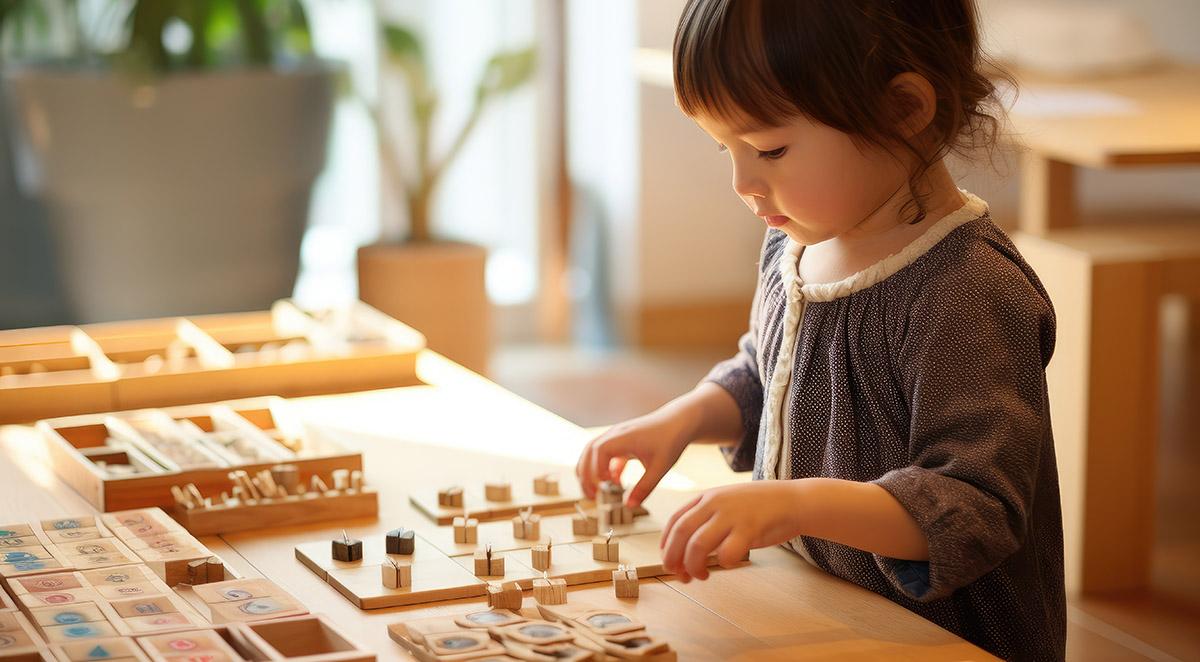
Everything in a Montessori classroom has a purpose and a place, from the low shelves children can reach to the beautiful, purposeful materials arranged in order of difficulty. Our classrooms give children a sense of security and independence, so they can move through the room, choose an activity, and put it away without needing an adult at every step.
Hands-On Materials and Mixed Ages
The materials are one of Montessori's most distinctive features. A child learning about quantity might build numbers with golden beads; a child learning letters might trace sandpaper shapes while saying the sound. Because the content is embodied in physical, self-correcting work, children often grasp concepts more deeply than they would by simply listening (Lillard et al., Frontiers in Psychology, 2017). Mixed-age grouping then adds another layer: younger children learn by watching older ones, and older children deepen their mastery by helping and mentoring.
What a Montessori Classroom Looks Like
The first thing many families notice in a Montessori classroom is the sense of purpose. Children are engaged throughout the room: choosing work from accessible shelves, gathering materials, reading in a quiet corner, collaborating with classmates, or meeting with a teacher for a lesson. The classroom feels calm and active because children are learning how to manage their time, care for their environment, and take ownership of their work.
The Work Cycle
Much of this happens during what Montessorians call the work cycle, a long, uninterrupted block of time, often two or three hours, when children choose and complete their own work. Work cycles give children the space to concentrate deeply, follow an interest, and experience the satisfaction of finishing something on their own timeline.
Practical Life and the Senses
You'll also notice areas devoted to what Montessorians call practical life: pouring, buttoning, food preparation, and caring for the classroom. These everyday activities may look simple, but they build concentration, coordination, and independence, laying the groundwork for later academic work. Nearby, sensorial materials help children refine their senses and begin to classify the world by size, shape, color, and sound.
Academic Growth Through Meaningful Learning
Families in Huntsville understand the value of a strong academic foundation. They want children who are prepared for advanced learning, able to think critically, and confident when facing new challenges.
Montessori is an evidence-informed approach built around how children develop and learn best. Students have time to focus deeply, explore questions, conduct research, and practice skills until they truly understand them. Teachers guide each child’s progress closely, using careful observation and a thoughtfully designed environment to support growth.
A 2023 systematic review examining 32 studies found that Montessori education was associated with stronger outcomes across academic and non-academic measures compared with conventional education (Randolph et al., Campbell Systematic Reviews, 2023). Earlier research has also highlighted positive outcomes related to academic achievement, executive function, and social development in authentic Montessori programs (Lillard et al., 2017).
Part of what drives these results is developmental timing. The early years of child development are a period of remarkable growth, when a child forms 700 to 1,000 new neural connections every second (Center on the Developing Child, Harvard University). Montessori is designed to meet children during these sensitive windows with exactly the kind of hands-on, self-directed experiences that support how their brains are wired to learn.
A simple example brings this approach to life. To understand place value, Montessori students work with materials that allow them to physically build numbers using units, ten-bars, hundred-squares, and thousand-cubes. They can see the relationship between quantities, feel the difference in size and weight, and develop a concrete understanding before moving to more abstract work. By giving children a way to explore ideas with their hands, Montessori helps students build understanding that lasts.
Children Thrive at MSH When They...
Are curious about the world around them
Children who ask questions, investigate ideas, and want to understand how things work find opportunities to explore through research, hands-on learning, and real-world experiences.
Enjoy meaningful work
Students have time to concentrate, practice skills, and follow their work through to completion. They learn the satisfaction that comes from solving problems, pursuing questions, and seeing their own progress.
Are growing into independence
Children learn to make thoughtful choices, care for their classroom environment, and contribute to their community. These daily experiences build confidence and responsibility that extend beyond school.
Value connection and belonging
Students build strong relationships with teachers and classmates in a community where they are known as individuals. Mixed-age classrooms allow children to learn from one another, develop leadership, and grow together over time.
Children do not need to arrive with every one of these qualities already developed. Montessori is designed to help children strengthen them over time.
Montessori in Huntsville: What Local Families Should Know
For Huntsville families ready to explore Montessori, the Montessori School of Huntsville offers an authentic program with deep local roots. Founded in 1965, MSH is a secular, nonprofit, parent-governed school, and it's verified by the American Montessori Society and accredited by SAIS and Cognia.
MSH also stands out for its continuity. The school serves children from infancy through 9th grade, so a family can begin with the Montessori Mornings infant and caregiver program and continue through the toddler, primary, elementary, and middle-school years without ever switching schools or philosophies. For families weighing affordability, MSH is also an approved provider under Alabama's CHOOSE Act education savings account program, which can help offset tuition for eligible students.
Frequently Asked Questions
What ages does Montessori education serve?
Montessori spans a wide developmental range, from infancy through adolescence. In Huntsville, MSH serves children from infancy through 9th grade, beginning with an infant and caregiver program for babies 3 to 18 months.
Is Montessori a religious approach?
No. Montessori is an educational method. At MSH, we are a secular, nonprofit school that welcomes families of all backgrounds and beliefs.
Do Montessori children transition well to other schools?
Generally, yes. Because Montessori builds independence, focus, and strong foundational learning skills, children often adapt well when they move to a new setting. The self-direction they develop tends to serve them across many environments.
Is Montessori only for preschool?
No. While Montessori is well known for early childhood, the method extends through elementary, middle school, and beyond. MSH carries the approach all the way through 9th grade.
Is there a Montessori school in Huntsville?
Yes. The Montessori School of Huntsville is an accredited Montessori school in South Huntsville serving families from infancy through 9th grade.
Bringing It All Together
At its heart, Montessori is a method that trusts children to be active, capable participants in their own learning, supported by a prepared environment and skilled, observant teachers. It's structured yet flexible, hands-on yet rigorous, and it's backed by a growing body of research showing real benefits for children.
If you're curious whether it's the right fit for your family, the next step is an easy one. Schedule a tour or reach out to our admissions team to see a Montessori classroom in action and ask all the questions on your mind.